
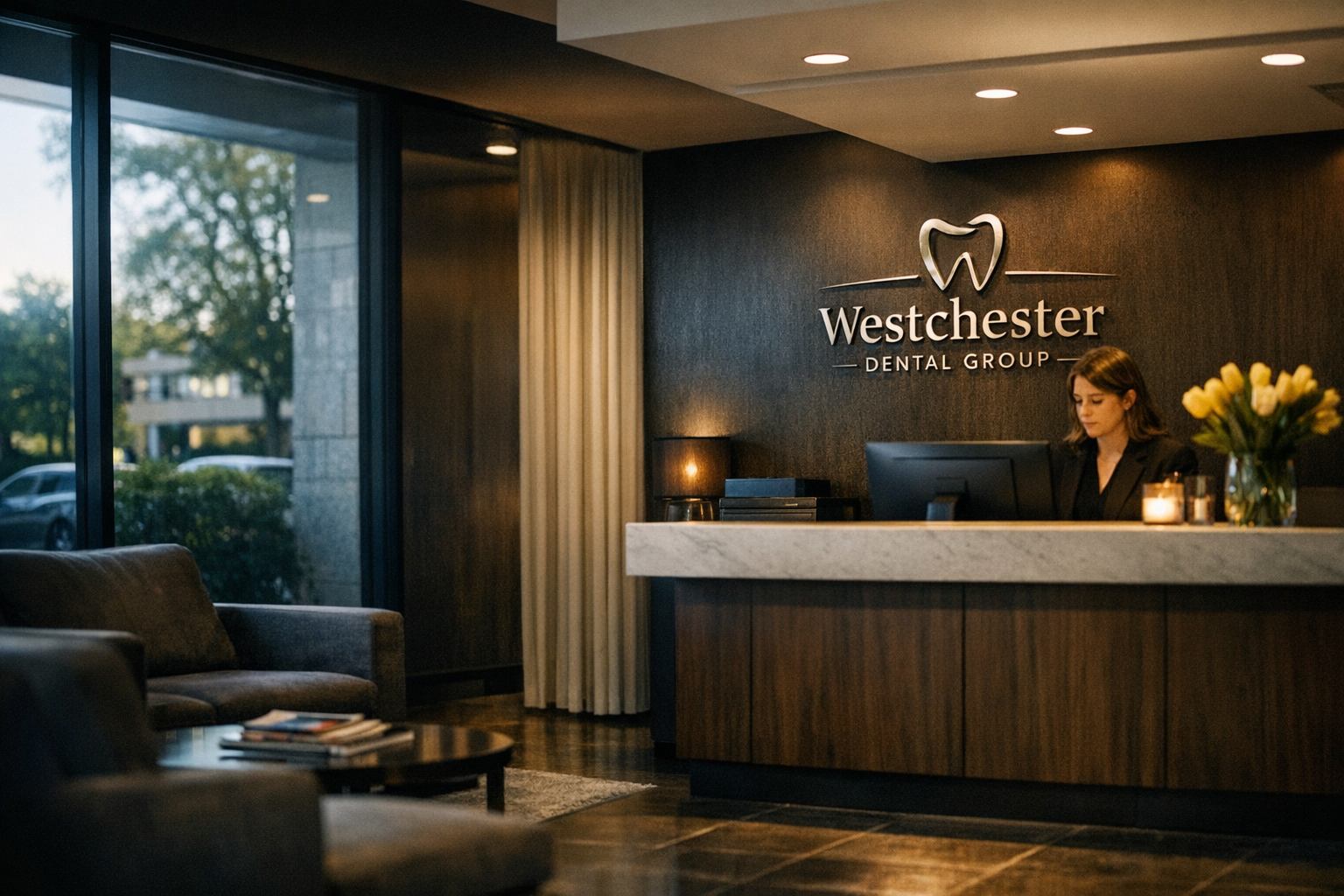
Most dental practice websites in Westchester are underperforming for one simple reason: they were built to exist, not to convert. They look acceptable. They list services. They have a phone number in the corner and a smiling stock photo on the homepage. And they quietly lose new patients every week.
That loss is rarely obvious from inside the practice. The schedule may still be full enough. Referrals may still be coming in. Existing patients may still be loyal. But the website is often failing at the exact moment it matters most: when a prospective patient is comparing three dentists in Scarsdale, White Plains, Rye, or Bronxville and deciding who feels credible, modern, and worth calling.
A website redesign, done correctly, is not a cosmetic project. It is a revenue project. It changes how a dental practice is perceived, how easily people find the practice, and how many visitors actually become booked appointments. For a dental office competing in Westchester County, that matters more than most owners realize.
A redesign changes how patients judge your practice before they ever call
Your website is often the first real consultation, whether you like it or not
Dental practice owners usually think the real sales process starts on the phone or in the chair. It doesn’t. It starts the second someone lands on your website. Before they care about your credentials, technology, or treatment philosophy, they are making a faster and more emotional judgment: does this place feel trustworthy, current, organized, and professional?
An outdated site sends the opposite message. If the design looks old, the photos feel generic, the mobile experience is clunky, or the content is thin, people make assumptions they may never say out loud. They wonder whether the office is behind the times. They wonder whether patient communication will be frustrating. They wonder whether the experience will feel impersonal. None of that may be true, but your website is making the argument for them.
This is especially important in dentistry because patients are not buying a commodity. They are buying confidence. They are choosing who will examine their child, handle a cosmetic case, manage a painful issue, or help them through long-postponed treatment they already feel anxious about. In that situation, design is not decoration. It is trust infrastructure.
A strong redesign helps a dental practice communicate the right signals quickly. Clear service positioning. Clean navigation. Real photography of the office and team. A calm visual style. Strong before-and-after proof where appropriate. Straight answers to practical patient questions. Prominent scheduling options. These are not minor improvements. They shape whether visitors stay long enough to take the next step.
Many Westchester practices still rely on websites that feel like digital brochures from another era. They say things like “welcome to our practice” and “we provide quality care” as if that differentiates anything. It doesn’t. Patients are looking for evidence, clarity, and ease. If your site does not deliver those instantly, a redesign is not optional. It is overdue.
Better design improves conversions, not just appearance
The biggest mistake dental practices make is treating redesign as a branding exercise with no operational outcome. In reality, the real value is in conversion performance. More calls. More form submissions. More appointment requests. More high-intent patients taking action instead of bouncing back to Google.
A redesign should remove friction everywhere. On mobile, patients should be able to tap to call without hunting for the number. Appointment requests should be simple, not buried in a long generic contact form. Service pages should help people self-identify quickly: emergency dentistry, Invisalign, cosmetic work, implants, family care. If they have to guess whether you do what they need, they leave.
This is where many practices lose money without realizing it. They invest in local visibility, referrals, signage, even paid ads, then send people to a site that creates doubt. The traffic is not the problem. The destination is.
Done well, a redesign improves the entire patient acquisition path. It aligns messaging with intent. Someone searching for a cosmetic dentist in Westchester should not land on a vague homepage and have to dig. Someone with a broken tooth should not have to scroll through filler copy to figure out whether you handle urgent cases. Someone comparing family dentists should immediately understand what makes your office easier, friendlier, or more efficient than the one down the street.
The practices that win online usually are not the ones with the fanciest site. They are the ones with the clearest one. Every page has a job. Every section reduces hesitation. Every click moves toward contact.
If your current site looks dated, feels hard to use, or fails to convert visitors into real patient inquiries, a focused website redesign for your Westchester County practice is often the fastest way to improve the return on your existing traffic.
A redesign strengthens local visibility and attracts better patient opportunities
Search performance improves when the site is built for how people actually choose dentists
Plenty of dental websites struggle in local search not because the practice lacks authority, but because the site structure is weak. Important services are lumped together on one thin page. location relevance is vague. Metadata is neglected. Internal linking is messy. Pages load slowly. Mobile usability is poor. The site gives Google very little confidence about what the practice actually offers and where.
A redesign is the right moment to fix that foundation.
For a Westchester dental practice, local search visibility is not about chasing vanity rankings. It is about owning the searches that signal real patient intent. “Dentist in White Plains.” “Dental implants in Scarsdale.” “Emergency dentist near me.” “Pediatric dentist Westchester County.” Those searches lead directly to booked appointments when the site is structured properly.
That means creating focused service pages, clear geographic relevance, strong page hierarchy, faster load times, and content that reflects how real patients search and compare. It also means removing the clutter that weakens performance. Too many practices bury their best opportunities under generic pages that try to say everything and end up ranking for nothing.
A redesign can also improve your Google Business Profile performance indirectly by giving users a better destination after they click. That matters. If searchers land on a page that matches what they were looking for, stay longer, and take action, that strengthens the quality of your digital presence overall.
This is where business owners should be more demanding. If an agency talks only about colors, fonts, and visual refreshes, they are solving the smallest part of the problem. A dental website should be redesigned around search intent, conversion paths, and local competition. In Westchester, where patients often compare several nearby practices before making a decision, that strategic layer is what separates websites that look nice from websites that actually produce growth.
If search visibility is part of the problem, redesign and SEO should not live in separate conversations. Your site should be rebuilt to support both. For practices that need stronger rankings alongside a better patient experience, integrating a clear SEO strategy in Westchester County makes the redesign substantially more valuable.
The right redesign helps you attract the cases you actually want
Not every patient inquiry has the same value. This is another point many dental practices miss. A better website does not just bring in more leads. It helps shape the type of leads you get.
If your practice wants more high-value restorative cases, cosmetic consultations, implant inquiries, or Invisalign patients, the site needs to speak directly to those services with confidence and specificity. If your site treats every service like an afterthought, you force high-intent visitors to do extra work. Most won’t. They move on to a competitor whose website answers their questions faster and presents the service more clearly.
The same goes for patient fit. Maybe you want to position the practice around premium care, modern technology, convenience for busy families, sedation options for anxious patients, or a more elevated cosmetic experience. A redesign gives you control over that positioning. Without it, the market fills in the blanks for you.
This matters in Westchester because many dental practices are competing in towns where perception drives value. In affluent communities, patients are often highly selective. They are not choosing based on proximity alone. They are choosing based on confidence, polish, and clarity. If your website undersells the actual quality of your care, you are creating a gap between what your practice is and what the market sees.
A strategic redesign closes that gap. It allows the website to reflect the level of the practice, support stronger fee integrity, and reduce the kind of low-quality inquiries that drain staff time. Better patient education, better service segmentation, better pre-qualification, and better calls to action all help the front desk spend less time sorting through weak leads and more time converting the right ones.
The operational impact is real. Fewer missed opportunities. More qualified inquiries. More confidence during patient follow-up. Better alignment between what the practice wants to grow and what the website is actually promoting.
That is the real business case for redesign. Not that the site looks newer, but that it starts functioning like an asset instead of a liability. For a dental practice in Westchester County, that shift can influence everything from monthly new patient volume to case mix to long-term brand strength in the communities you serve.