
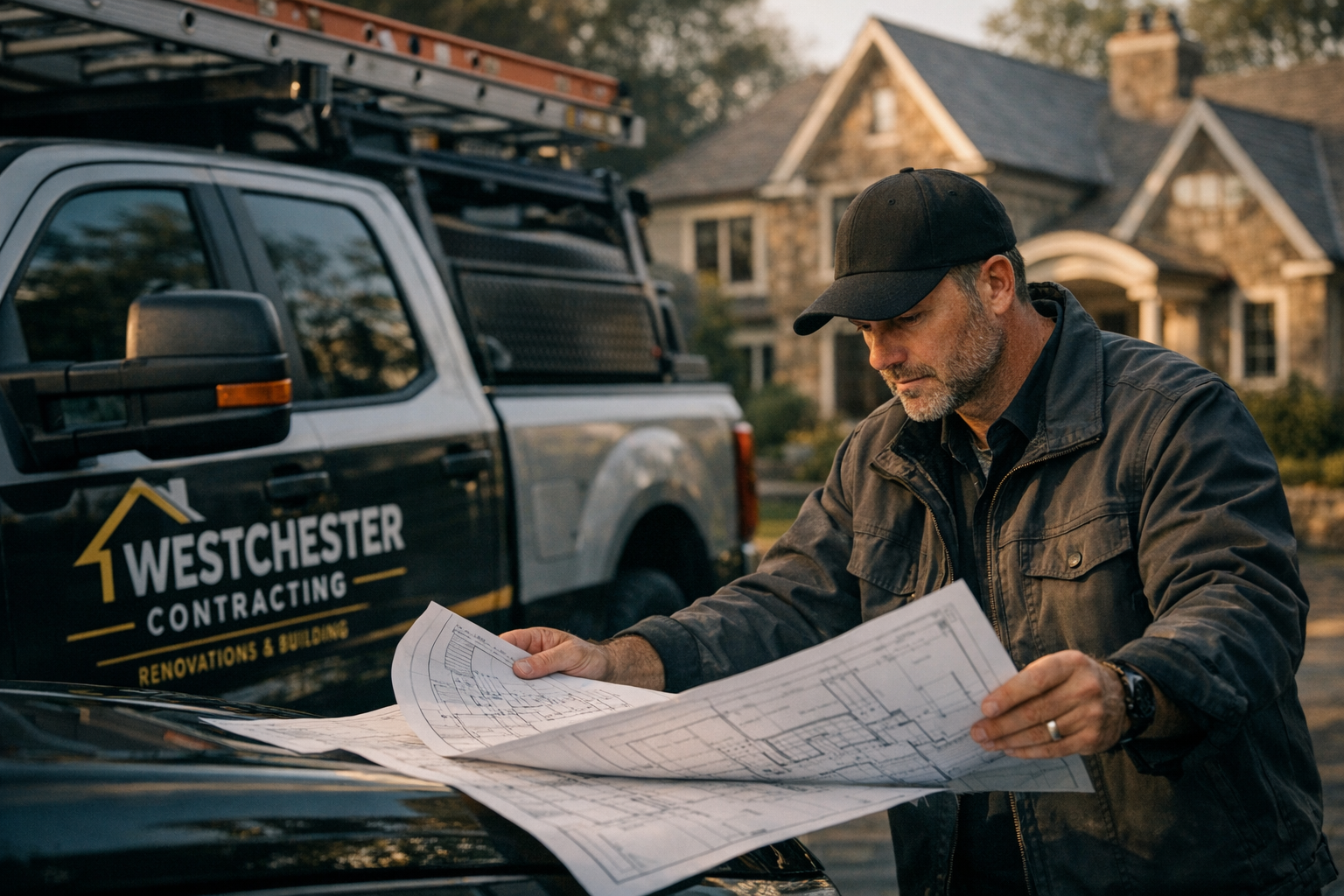
If you run a contracting business in Westchester County, you already know the work itself is only part of the sale. Homeowners are not just comparing price, scope, and timeline. They are comparing confidence. They are trying to decide who feels safest to hire for a $30,000 kitchen, a $90,000 addition, or a six-figure renovation that will disrupt their home for months.
That decision often happens before you walk the property.
A contractor can have better crews, better subs, tighter project management, and more honest pricing than the competitor down the road and still lose the bid. Not because the other company is better. Because they look better online.
That stings because it feels unfair. But it is also fixable.
In Westchester, perception carries real weight. Homeowners in Scarsdale, Rye, Bronxville, Chappaqua, Larchmont, and Bedford are not casually hiring. They are screening for professionalism, taste, reliability, and risk. If your website looks dated, your project photos feel random, your reviews are thin, or your digital presence sends mixed signals, prospects start creating a story about your business. Usually not a flattering one.
And once that story forms, your estimate has to fight uphill.
This is where most contractors get it wrong. They think online presentation is vanity. They assume referrals should be enough. They believe if someone really wants quality, they will judge based on the meeting, the proposal, and the price. That is not how people buy anymore, especially in affluent service markets.
Your online presence is not decoration. It is your pre-sales process.
When it is weak, you lose trust before you get the chance to earn it. When it is strong, homeowners come into the conversation already expecting you to be the professional option.
Your Online Presence Is Deciding the Bid Before the Estimate Does
Homeowners Use Your Digital Presence to Measure Risk, Not Just Style
A homeowner looking for a contractor is not thinking like a marketer. They are thinking like someone trying to avoid a nightmare. Delays. Change orders. Ghosting. Sloppy finishes. Unreturned calls. A crew that damages the property. A project that drags six months beyond schedule.
So when they look you up, they are not simply asking whether your site looks modern. They are asking whether you look organized enough to trust with their home, their money, and their time.
This is where many solid contractors sabotage themselves.
They have a website that was built years ago by a cousin, a freelancer, or a low-cost agency that never understood how homeowners evaluate service businesses. The homepage says vague things like quality craftsmanship and customer satisfaction. The photos are inconsistent. The navigation is clunky. Service pages are thin or missing. There is no clear proof of the kinds of projects they actually want more of. Sometimes the site is slow, broken on mobile, or impossible to use without pinching and zooming.
To the contractor, none of that feels urgent. To the homeowner, it signals operational sloppiness.
That may not be fair. It is still real.
If a competitor has a cleaner brand, stronger project photography, a more credible website, tighter messaging, and visible evidence of work in the exact towns and price ranges your prospect cares about, that competitor starts with an advantage. Not because their framing is better. Because they reduced perceived risk faster.
And in premium local markets, reduced perceived risk often beats lower price.
This matters even more in Westchester because the customer base tends to be selective, research-heavy, and image-conscious. A homeowner spending serious money on a renovation in an upscale neighborhood is not hiring the company that merely seems capable. They are leaning toward the company that appears established, predictable, and in control.
That is why design, messaging, and structure on your website directly affect revenue. A strong site does not just make you look nicer. It makes your business easier to choose.
If your current site is making you look smaller, less current, or less premium than the work you actually deliver, that gap is costing you bids. In many cases, a focused website redesign for Westchester County contractors is not a branding upgrade. It is a sales correction.
The Competitor Who “Looks Better” Usually Tells a Better Story
Most contractors assume they are losing because the other company had better reviews or lower pricing. Sometimes that is true. More often, the competitor simply made the homeowner's decision easier.
They showed the right work. They explained their process clearly. They presented themselves in a way that matched the level of investment they were asking for.
That is what most contractor websites fail to do.
They dump visitors into a generic homepage and force them to piece things together. Maybe there is a services list. Maybe a few photos. Maybe a contact form with no context. There is little strategy behind the flow. Nothing builds conviction. Nothing anticipates the homeowner's questions. Nothing addresses the emotional side of hiring someone for a large project.
A better competitor uses the website as a filtering and trust-building tool.
They have project examples that feel relevant, not random. A homeowner considering a high-end bathroom remodel sees polished work that resembles the quality and style they want. Someone planning a full-home renovation sees evidence that this contractor can manage complexity, not just swing a hammer. Testimonials reinforce communication, cleanliness, scheduling, and professionalism, not just that the finished room looked nice.
The competitor may also be doing a better job with local credibility. Instead of trying to look broad and generic, they look anchored in the communities they serve. They reference Westchester neighborhoods, show completed work that fits the architecture and expectations of the area, and make it obvious they understand the local customer.
That kind of relevance matters. Homeowners do not want to feel like just another lead in a giant service radius. They want confidence that you have done this kind of work for people like them.
And then there is proposal-stage reinforcement. After the walkthrough, many homeowners go back online and look again. They review your site more carefully. They compare your estimate against your digital presence. If your proposal says premium but your website says outdated, that mismatch hurts. If your pricing reflects quality but your online brand looks cheap, you have created friction you did not need.
The contractor who wins is often the one whose online story makes the quoted number feel justified.
The Fix Is Not More Marketing Noise. It Is Better Proof, Positioning, and Conversion
Your Website Should Pre-Sell the Job You Want, Not Just Collect Inquiries
A lot of contractors respond to slow growth the wrong way. They buy leads. They dabble in ads. They post scattered photos on social media. They ask for referrals more aggressively. None of that fixes the core issue if your digital presence fails to support the type of business you want to attract.
The real job of your website is not to exist. It is to shape buyer behavior.
That means it should help the right prospect quickly answer four questions.
Do these people do the kind of work I need?
Can they handle a project at my level?
Will they be organized and professional to deal with?
Do I trust them enough to call?
Most contractor websites answer none of those clearly.
Instead, they try to appeal to everyone. Roofing, siding, kitchens, bathrooms, decks, basements, masonry, windows, additions, painting, and emergency repairs all crammed into one vague experience. The result is a business that feels unfocused, even when the company is actually capable.
A stronger approach is selective clarity. Show the work you want more of. Build pages around real service lines. Use photography that reflects the caliber of your jobs. Write copy that sounds like a serious company, not a template. Make the process feel transparent. Remove friction from contact. Use reviews as proof of how you operate, not just that customers liked the result.
This is especially important for contractors trying to move upmarket. You cannot charge for premium work while presenting yourself like a budget option. Homeowners notice the mismatch immediately.
A serious website should also support the realities of how people browse now. They are looking on their phones, often between meetings, late at night, or while comparing multiple contractors at once. If your site is slow, confusing, or visually weak, they will not struggle through it. They will move on.
If your business already has the reputation and workmanship but your online presence is lagging behind, investing in a stronger contractor website in Westchester County is one of the most practical ways to improve close rates without chasing junk leads.
Because the best outcome is not more estimates. It is more of the right estimates, with trust already established before the first appointment.
What Actually Wins More Bids in Westchester
The contractors who consistently win better jobs in Westchester are not always the cheapest. They are not always the oldest either. They simply understand how modern trust works.
They know that homeowners are buying the experience of certainty as much as the work itself.
So what actually moves the needle?
First, sharp positioning. A contractor who looks like they know exactly who they serve and what projects they specialize in is easier to hire than one who tries to look like everything to everyone. That does not mean narrowing your capabilities. It means presenting them with discipline.
Second, project proof with context. Not just a gallery. Not just before-and-after shots. Real examples that help a homeowner see themselves in the work. What kind of home was it? What problem was being solved? What level of finish was involved? What did the result feel like? This gives your prospect something to connect to beyond price.
Third, credibility signals that reflect how clients really choose. Licenses and insurance matter, but they are baseline. What separates you is visible professionalism. Consistent branding. Strong reviews. Clean photography. Clear process. Useful service pages. Fast mobile performance. A site that feels current. These are not cosmetic details. They are commercial assets.
Fourth, local specificity. Westchester is not one monolithic market. The expectations in Katonah are not identical to the expectations in White Plains or Pelham. The more your website reflects genuine familiarity with the area and the kinds of homes you work on, the more believable you become.
Fifth, follow-through between the website and the sales conversation. If your online presence promises responsiveness, your follow-up needs to be quick. If your site communicates premium execution, your estimate needs to look polished. If your digital brand suggests order and professionalism, the in-person experience needs to confirm it. The mistake many businesses make is treating the website and sales process as separate things. Customers experience them as one continuous signal.
This is why some contractors keep losing bids they think they should win. Their actual capability may be strong, but the signals around that capability are weak, inconsistent, or outdated. Homeowners fill in the blanks, and they rarely fill them in generously.
The good news is that this problem is measurable and fixable.
When a contractor improves the way the business is presented online, the effect is not abstract. Better-fit leads. Less price resistance. Stronger first impressions. Higher-quality inquiries. More confidence during the estimate process. Better close rates on the jobs that matter.
In other words, the website stops being a brochure and starts acting like part of the sales team.
That is the shift. And in a market like Westchester County, it is often the difference between competing on price and being chosen on trust.