
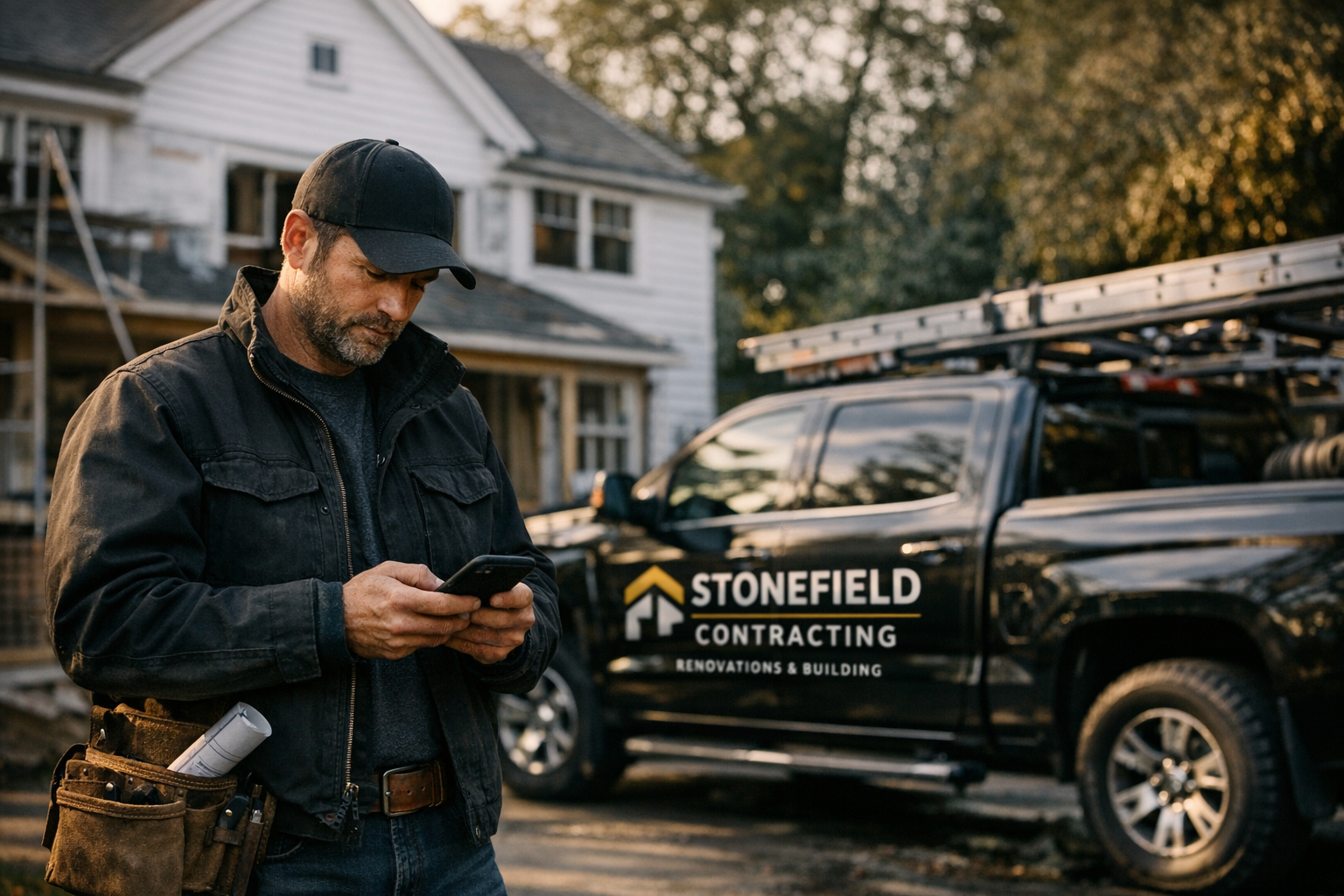
If you're a contractor in Fairfield County and your business doesn't show up on Google Maps, this isn't a visibility problem. It's a revenue problem.
When a homeowner in Westport searches “kitchen remodeler near me,” or someone in Stamford types “roof repair contractor,” they are not casually browsing. They need someone now, and they're usually ready to call the first credible company they find. If your business is missing from the map pack, you're not even getting a shot.
Most contractors assume the issue is simple: maybe Google is glitching, maybe the profile just needs more time, maybe reviews are the only thing that matters. None of that is the full story. In most cases, a contractor disappears from Google Maps because the business has weak local signals, inconsistent profile data, poor website support, or a setup that tells Google the company isn't the best answer for that local search.
And here's the part most businesses get wrong: they treat Google Maps like a listing. It isn't. It's a local ranking system. Google is deciding who deserves visibility based on trust, relevance, and geographic strength. If your company is not sending the right signals, a competitor with a smaller business and a worse website can still outrank you.
Your Google Business Profile Is Probably Incomplete, Weak, or Sending Mixed Signals
A lot of Fairfield County contractors create a Google Business Profile, verify it once, and assume the job is done. Then they wonder why competitors show up in Norwalk, Fairfield, Greenwich, and Bridgeport while they barely appear for their own town. Google does not reward half-finished profiles or vague businesses. It rewards clarity.
Your primary category, service areas, and business details are likely working against you
This is where many contractors quietly bury themselves. They choose a broad or inaccurate primary category, add a few random services, set a giant service radius, and call it optimized. Google sees that kind of setup all the time, and it usually reads like weak local relevance.
If you're a roofing contractor, remodeling company, siding installer, or painter, the category needs to match the main revenue-driving service you want to rank for. Not the service you occasionally offer. Not the label that sounds most professional. The one tied directly to what customers search when they're ready to hire.
Then there are service areas. Many contractors in Fairfield County try to rank everywhere at once. They add every town they can think of, from Danbury to Darien, hoping broader reach means more visibility. Usually the opposite happens. Google wants confidence that you are truly relevant to a searcher in a specific place. When your profile looks spread too thin, your local authority weakens.
Business descriptions are another missed opportunity. Most are either generic, stuffed with keywords, or clearly written for search engines instead of humans. Google is better at spotting that than many business owners realize. A strong description reflects what you actually do, where you do it, and why customers trust you. It should sound like a real company, not a template.
Photos matter too, but not in the superficial way people think. You do not need polished branding shoots. You need real proof. Exterior job photos, in-progress renovation shots, finished interiors, crews on-site, branded vehicles, materials, neighborhoods you actually work in. Those images reinforce legitimacy. A profile with weak visuals often looks inactive, and inactive businesses don't inspire confidence from users or Google.
If your visibility problem starts with an underperforming profile, the fix isn't adding a few keywords and hoping for the best. It usually requires tightening the entire local footprint around the profile and supporting it with stronger search signals. That's exactly where a serious SEO strategy for local service businesses starts to make the map listing more competitive instead of just more complete.
Reviews, updates, and engagement are not optional if competitors are active
A lot of contractors know reviews matter. Fewer understand why they matter.
Reviews are not just social proof for homeowners comparing bids. They are one of the clearest trust signals Google can measure at scale. Quantity matters. Quality matters. Recency matters. The words inside the reviews matter. If your last review was eight months ago and your top competitor in Fairfield gets two detailed reviews every week, Google has plenty of evidence that the competitor is more active, more trusted, and more relevant.
The same issue applies to owner responses. Contractors often ignore them because they seem cosmetic. They aren't. A business that regularly responds to reviews, answers questions, updates services, and posts real business activity sends a stronger activity signal than a profile that just sits there.
Google Posts won't rescue a bad profile, but they can support a healthy one. Job highlights, seasonal service reminders, before-and-after project spotlights, storm repair updates, and local project announcements all reinforce relevance. More importantly, they show that the business is operating now, not just existing online.
Q&A is another neglected area. Homeowners ask practical questions before they call: Are you licensed and insured? Do you serve New Canaan? Do you handle additions or just renovations? If those questions are unanswered, or worse, not present at all, your profile loses another chance to convert interest into action.
This matters because Google Maps is not just ranking businesses. It's ranking businesses that appear likely to satisfy the user quickly. A profile with weak engagement looks like a gamble. A profile with recent reviews, active responses, strong visuals, and useful updates looks safer.
And in local search, safer often wins.
Your Website and Local Authority May Be Too Weak to Support Map Rankings
This is the part many contractors miss entirely. They think Google Maps rankings live inside the Google Business Profile. They don't. Your profile is only one piece of the decision.
Google uses your website, local citations, location relevance, and broader authority signals to determine whether your business deserves visibility. So if your profile looks decent but your website is vague, outdated, thin on location signals, or disconnected from your actual service areas, the map ranking stalls.
Your website may be too generic to rank in specific Fairfield County towns
A contractor website that says “we serve all of Connecticut” sounds broad to the owner and useless to Google.
If you want to show up for searches tied to Fairfield, Trumbull, Wilton, Greenwich, or Stamford, your website has to support those locations in a believable way. That does not mean publishing junk pages with town names swapped out. Google has seen that trick for years, and it rarely produces durable rankings.
What works is location-specific proof. Project pages in actual towns. Service pages that clearly explain what you do. Testimonials tied to local communities. Structured content around remodeling, roofing, masonry, painting, or home additions with enough detail to show expertise. Contact information that matches your business profile exactly. Fast mobile performance. Clear calls to action. Real signs that this is a legitimate local company, not an SEO shell.
Many contractor sites fail here because they were built like digital brochures. They look fine, but they don't help Google understand where the business is strongest or what services deserve local visibility. Worse, some are so outdated or slow that they quietly undermine trust before a homeowner even makes contact.
If your site is holding back your map visibility, a stronger local website is not cosmetic. It's infrastructure. For contractors trying to compete town by town, a better-performing, better-structured website often becomes the difference between getting ignored and getting calls. If your current site is outdated or too thin to support local rankings, a focused website redesign for service businesses is often the practical next move.
Citation issues, inconsistent business data, and proximity myths keep contractors stuck
Contractors love simple explanations, which is why “it's all about proximity” gets repeated so often. Yes, proximity matters. But it's not the whole game.
If two contractors are both near the searcher, Google still has to choose. That's where citation accuracy, business consistency, and local authority come in. If your business name, address, phone number, website, and service details are inconsistent across directories, local listings, trade sites, and data sources, Google gets mixed signals. Mixed signals lower trust.
This happens more than owners think. One old Yelp listing has the wrong suite number. Angi uses an outdated phone number. Houzz links to an old website. Facebook lists a different business name variation. The Google profile says one thing, the website says another, and local directories say something else. None of those issues seem dramatic on their own. Together, they make your local presence less reliable.
Then there are businesses trying to rank from virtual offices, shared spaces, or addresses that don't reflect real customer-facing operations. Google has become much stricter about this. If your listing setup looks questionable, visibility can drop fast, or the profile can get suspended outright.
Authority also extends beyond your own website. Mentions from local chambers, regional publications, supplier relationships, trade associations, sponsorships, and trusted directories all strengthen the local footprint. Contractors often underestimate this because it feels indirect. But local search is built on accumulated confidence. Google wants corroboration.
The hard truth is that most contractors who don't show up on Google Maps are not being punished. They're just being outclassed by businesses with stronger local ecosystems.
That is fixable. But it requires treating local search like a competitive channel, not a profile setup task. In Fairfield County, where homeowners compare multiple options quickly and higher-ticket jobs depend on immediate trust, that difference shows up directly in your pipeline.
If you're invisible on Maps, the market is not waiting for you to catch up. It's already calling the next contractor.