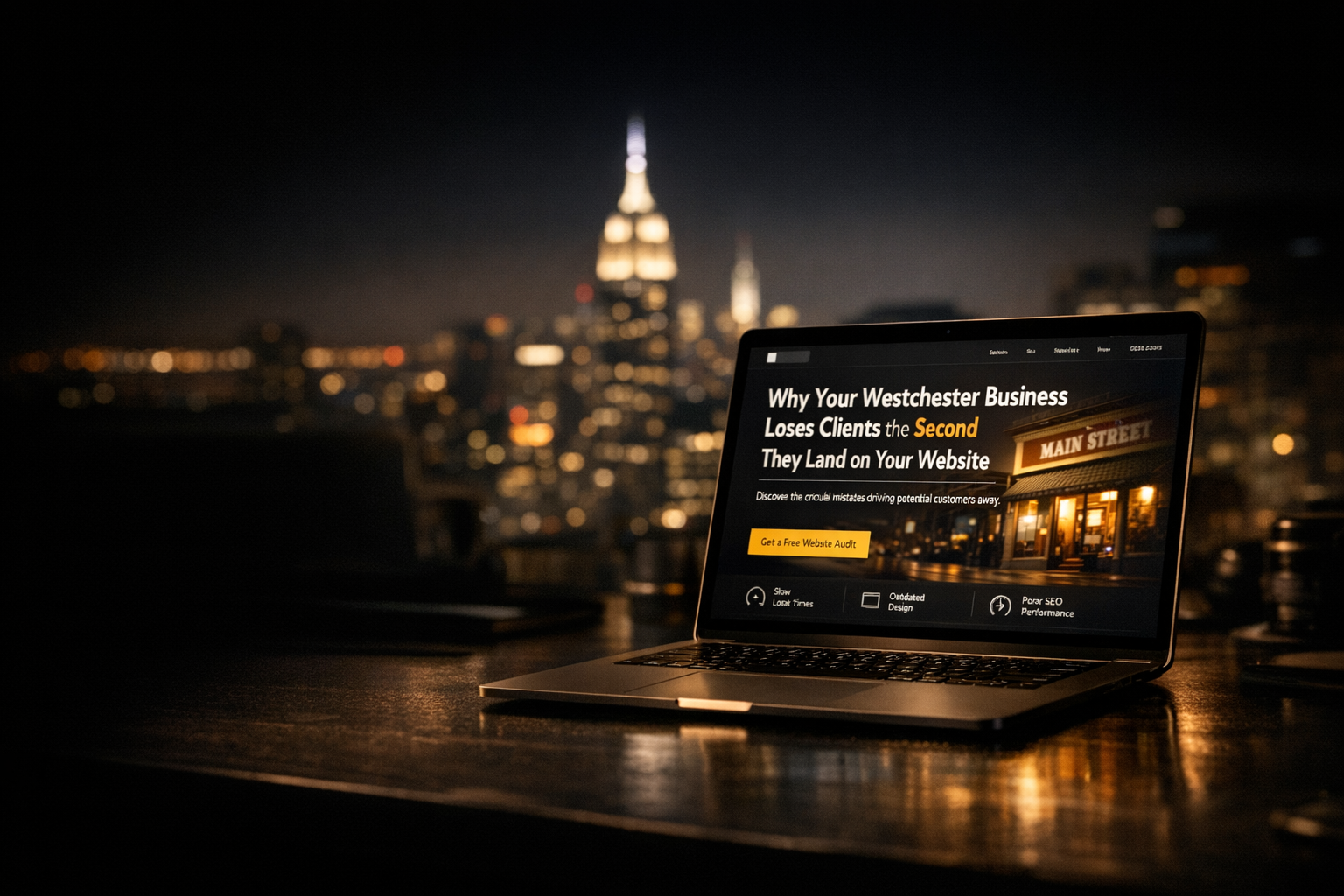
A lot of Westchester business owners think they have a lead generation problem when they actually have a website problem.
Traffic comes in. People click around. Then nothing happens.
No call. No form fill. No booked consultation. No sale.
That usually leads to the wrong reaction. More ad spend. More social media posts. More SEO content. More outreach. Meanwhile the real issue stays untouched: the website is quietly repelling the exact prospects you want.
This happens every day across Westchester County. A law firm invests in Google Ads but sends expensive traffic to a slow, vague homepage. A home services company ranks well in search but buries its service areas and phone number. A medical practice has a polished logo and beautiful photography, but the site never answers the basic question every serious prospect is asking: why should I trust you over the other options five minutes away?
Your website does not get judged gradually. It gets judged immediately.
Within seconds, visitors make a series of brutal decisions. Does this business look credible? Does it feel current? Is it clear what they do? Is this for someone like me? Can I trust them with my money, time, home, health, legal matter, or reputation? If the answer is fuzzy, they leave.
They do not send feedback. They do not explain what felt off. They just disappear and hire somebody else.
For local businesses in Westchester, this hurts more than most owners realize because your prospects are often high-intent. They are not casually browsing. They are comparing providers, narrowing options, and looking for a reason to move now. If your website creates friction, hesitation, or doubt, you are losing real revenue, not just vanity metrics.
Your website is creating doubt before your sales process even begins
Most businesses assume the website’s job is to “look professional.” That standard is far too low. Plenty of professional-looking websites still underperform because they fail where it matters: clarity, trust, and momentum.
A prospect does not land on your site hoping to admire your branding. They are trying to reduce risk. They want fast proof that you are competent, relevant, and easy to work with. When your site delays that proof, your sales process dies before anyone speaks to your team.
Vague messaging kills conversions faster than bad design
The most common mistake is also the most expensive: weak positioning.
A homepage headline that says “Innovative Solutions for Modern Businesses” tells nobody anything. “Committed to Excellence Since 1998” is not a reason to contact you. “Your Trusted Partner” is filler. These phrases are everywhere because they sound safe. In reality, they destroy momentum because they force the visitor to do the work of figuring out what you actually do.
Business owners often underestimate how impatient qualified buyers are. If someone lands on your site from search, a referral, or a local directory listing, they expect immediate clarity. What services do you offer? Who do you serve? In what locations? What problem do you solve? Why are you better than the alternatives? What should I do next?
If those answers are not obvious above the fold, your bounce rate is not a mystery. It is a direct consequence.
This gets worse in competitive local categories across Westchester. If you are a contractor in Scarsdale, a med spa in White Plains, an accountant in Rye, or an attorney in Yonkers, your prospects are not reading every page of your site out of courtesy. They are scanning for confidence signals and comparing you against two or three nearby competitors. The business with the clearest message usually wins more often than the one with the prettiest website.
What actually works is specific messaging that speaks to the buyer’s situation. Not clever language. Not broad claims. Specificity.
A stronger website does not say you offer “comprehensive legal services.” It says you help Westchester families navigate estate planning, probate, and elder law with clear guidance and fast response times. A stronger contractor site does not say “quality craftsmanship.” It says you design and build high-end kitchen renovations for homeowners in lower Westchester, with detailed proposals, realistic timelines, and clean project management.
Specificity signals competence. It tells the visitor you understand their problem and have solved it before.
If your current site looks polished but still fails to convert, that is usually the first place to look. Not the color palette. Not the font. The message.
And if the issue is deeper than copy alone, a serious website redesign in Westchester County is often what separates a site that merely exists from one that consistently produces qualified inquiries.
Trust breaks when your website feels outdated, confusing, or thin
A visitor may never consciously say, “This website feels risky,” but that is exactly what happens.
Trust erodes through small signals. Old-looking design. Stock photos that look staged. Cluttered navigation. Service pages with barely any substance. Broken mobile layouts. Generic testimonials with no names. No recent work. No proof of results. No visible location cues. No real explanation of process. No friction-free next step.
Each issue seems minor on its own. Together they create hesitation.
And hesitation is expensive.
Most business owners think prospects evaluate websites rationally. They do not. People assess credibility emotionally first, then justify it logically. If your site feels stale or sloppy, they assume your business operations may be the same. That may be unfair, but it is absolutely how buying decisions work.
This is especially true in affluent local markets. Westchester clients expect polish, but not empty polish. They want signs that your business is established, responsive, and current. A site that has not been updated in five years sends the opposite message, even if your business itself is excellent.
Thin websites are another silent killer. Many local businesses launch with a basic five-page site and never evolve beyond it. That leaves huge credibility gaps. A serious buyer wants depth. They want to see service details, local relevance, process, FAQs, proof, and signs of active business momentum. If your competitor has a more complete digital presence, your business looks smaller and less certain by comparison.
What works instead is a site built around trust architecture.
That means clear service pages, real client proof, local relevance, visible contact paths, direct calls to action, strong mobile usability, current visuals, and content that answers the objections buyers actually have. This is not about stuffing the site with more words. It is about removing uncertainty at every stage.
If your website currently creates friction instead of confidence, improving the user experience is not a cosmetic upgrade. It is a revenue decision. A strategically built website in Westchester County should make the next step feel obvious and low-risk, not like a commitment the prospect needs to think about for a week.
The businesses that win online make the first decision easy
The best-performing local websites do one thing exceptionally well: they reduce decision fatigue.
They do not try to say everything. They do not dump every service, every credential, every idea, and every menu option into one cluttered experience. They guide the buyer toward a clear next action by making the first decision easy.
That is where most websites fail. They ask for too much trust too early, while giving too little reassurance in return.
Too many websites force visitors to hunt for what should be obvious
When a prospect lands on your site, they are usually looking for a short list of things.
What do you do?
Do you serve my area?
Are you credible?
What happens next?
How do I contact you right now?
Yet many business websites make these answers unnecessarily hard to find. Navigation is overloaded. Service categories are vague. Contact information is buried. Buttons say things like “Learn More” instead of offering a concrete next step. Location pages are missing or weak. The mobile experience turns simple actions into work.
This is not just a usability issue. It is a conversion issue.
Every extra second spent searching creates drop-off. Every missing answer sends the visitor back to Google. Every unclear page increases the chance they call your competitor instead.
This is particularly damaging for businesses that rely on urgency or timing. If someone needs a roofer after a storm, a family lawyer during a stressful transition, or an urgent appointment with a specialist, they are not in the mood to decode your site architecture. The business that presents clear options and direct next steps gets the lead.
What works is ruthless simplification.
Your homepage should establish what you do, who you serve, and why you are credible in seconds. Your primary services should be visible immediately. Your local relevance should be unmistakable. Your phone number, form, or scheduling option should be easy to access on every device. Your calls to action should reflect intent: request a consultation, schedule an estimate, speak with our team, get pricing, book an appointment.
That sounds obvious. It is. Which is exactly why it is so costly when businesses ignore it.
The highest-converting websites are not necessarily the most elaborate. They are the easiest to understand and the easiest to act on.
Revenue goes to the business that removes risk, not the one that talks the most
A lot of websites try to win by making big claims.
Best in class. White-glove service. Industry-leading expertise. Unmatched commitment. Premium solutions.
This language is weak because every competitor says some version of the same thing. The prospect has learned to ignore it.
What they actually respond to is evidence.
Show them the types of clients you serve. Show them examples of work. Show them specific outcomes. Show them your process. Show them the neighborhoods, towns, and counties you operate in. Show them reviews that sound human. Show them a team that looks real. Show them what happens after someone reaches out.
Business owners often miss this because they are too close to their own company. They assume their reputation is already understood. It is not. Offline reputation does not automatically transfer online. A referral may get someone to your site, but the website still has to close the confidence gap.
That is why referred traffic often underperforms on weak websites. The referral created interest. The website introduced doubt.
The businesses that win understand that websites do not need to be louder. They need to be more convincing.
That means replacing broad claims with tangible proof. Replacing filler text with relevant detail. Replacing endless scrolling with strategic structure. Replacing design choices made for internal taste with decisions made for buyer behavior.
In practical terms, this might mean adding project galleries that actually show quality and scope. It might mean rewriting service pages around client concerns instead of internal jargon. It might mean featuring a timeline of what happens from inquiry to delivery. It might mean making pricing expectations clearer. It might mean putting location-specific trust signals in the right places instead of hiding them in the footer.
These changes sound small until you measure what they do. Better conversion rates. Better lead quality. More calls from ready-to-buy prospects. Less dependence on referrals alone. More return from every SEO click, ad click, and branded search.
That is the real point.
Your website is not a digital brochure. It is either strengthening your sales pipeline or weakening it.
If people are landing on your site and disappearing, the market is giving you an answer. Not about your industry. Not about the economy. Not about your logo.
About friction.
And the businesses that fix that friction usually do not need more traffic first. They need a website that earns trust fast enough to keep the opportunity alive.