Corporate catering buyers are not choosing between chicken marsala and grilled salmon. They are choosing between risk and certainty.
That is the mistake many catering companies in Westchester make when they review why they lost a bid, failed to get a callback, or watched a newer competitor land the account they wanted. They assume the decision came down to menu pricing, portion sizes, or a personal connection. Sometimes it does. Most of the time, it does not.
The companies winning recurring corporate business are usually not dramatically better in the kitchen. They are better positioned. They look easier to trust, easier to approve internally, and easier to work with when the order matters and the stakes are high. For an office manager planning a board lunch, an HR director managing employee events, or an executive assistant booking monthly leadership meetings, the safe choice wins.
That safe choice is rarely built through food alone. It is built through perception, process, and proof.
In Westchester County, where law firms, healthcare groups, financial services companies, real estate firms, private schools, and regional corporate offices all expect professionalism, a catering company can lose business even while delivering solid food and reliable service. If the company appears disorganized online, unclear in its offering, or difficult to evaluate quickly, buyers move on.
That is the real issue. Better-positioned competitors remove doubt faster.
Corporate buyers are not looking for a caterer, they are looking for a low-risk decision
A lot of catering businesses still sell like they are speaking to a bride, a family host, or someone planning a one-time celebration. Corporate buyers operate differently. They care about consistency, responsiveness, logistics, dietary reliability, scheduling, invoicing, presentation, and whether you will make them look competent in front of their team.
If your marketing talks mostly about passion, handcrafted dishes, and unforgettable flavor, you may be missing the criteria that actually decides corporate contracts.
Your competitors are selling certainty while you are selling food
This is where many Westchester catering companies quietly lose. Their website features beautiful trays, generic service descriptions, and broad claims like “perfect for any event.” That sounds harmless, but to a corporate buyer it often signals that the company has not thought deeply about business catering.
The better-positioned competitor says something more useful. They show office breakfast packages for 10 to 25 people, executive lunch service for client meetings, multi-day training session catering, individually packaged options for compliance-conscious workplaces, and event coordination for large internal functions. They make it obvious that they understand the corporate environment.
That matters because business buyers do not want to decode your capabilities. They want immediate answers to operational questions. Can you handle recurring orders? Can you accommodate gluten-free, kosher-style, vegetarian, vegan, and allergy-sensitive requests without confusion? Do you arrive early enough for room setup? Can you manage separate billing for departments or locations? Do you have a system for last-minute changes?
If a competitor makes those answers visible and you do not, they appear more qualified before anyone even tastes the food.
This is also where digital positioning starts affecting revenue in a very practical way. Your site is not just a brochure. It is often the first screening tool used by executive assistants, office administrators, and procurement teams. If your company looks dated, hard to navigate, or vague, you create doubt before the sales conversation starts. A strong website presence built for credibility and conversion can materially improve how often corporate buyers take the next step.
The painful part is that many owners never realize this is what cost them the account. They hear, “We went in another direction,” and assume they were underbid. In reality, they were out-positioned.
The buying experience often matters more than the proposal itself
Most catering companies focus heavily on the quote and not nearly enough on what happens before the quote arrives. Corporate clients notice the entire buying experience.
How quickly did you respond? Was the inquiry form simple or irritating? Did your menu PDF look polished or improvised? Were package options easy to compare? Did someone have to call just to understand your minimums, delivery area, or setup options? Did your follow-up answer questions clearly, or did it create more back-and-forth?
Businesses regularly lose contracts because the buying process feels heavier than it should. In a corporate environment, the person booking catering is usually not making their only decision of the day. They are juggling calendars, internal politics, dietary requests, budget pressure, and leadership expectations. If your process adds friction, you become the problem they avoid.
Meanwhile, the better-positioned competitor makes everything easier. Their website clarifies ordering windows, package tiers, service areas, and event types. Their inquiry flow captures the right details upfront. Their follow-up email feels organized. Their proposals look like they were made for business clients, not copied over from weekend event work.
This is where many catering brands in Westchester get trapped in a dangerous assumption: because they are good operationally, prospects will tolerate mediocre presentation. That is false. Buyers interpret sloppy digital presentation as a preview of service inconsistency.
If your site still looks like it was built years ago, or if your corporate offering is buried inside a general events page, a website redesign focused on how business clients actually evaluate vendors is not cosmetic. It is a sales issue.
Better-positioned competitors make procurement easier, proof stronger, and value clearer
Winning corporate contracts is not about sounding bigger than you are. It is about reducing buyer hesitation at every stage.
The strongest catering companies do this by packaging their value clearly. They do not force a prospect to infer why they are the right fit. They show it with structure, evidence, and specificity.
Weak positioning makes even a good catering company look replaceable
If your message sounds like every other caterer in Westchester, then price becomes the easiest comparison point. That is exactly where you do not want the conversation to go.
Generic positioning sounds like this: fresh ingredients, exceptional service, customized menus, memorable events. None of that is offensive. None of it helps. Every competitor says some version of the same thing.
Strong positioning is sharper. It says who you serve, what kinds of business needs you solve, and why your process works better for that client type. For example, a catering company might be the go-to choice for law firms needing discreet, punctual lunch service for client-facing meetings. Or for healthcare organizations that need dependable boxed lunches across multiple offices. Or for financial firms hosting investor updates where presentation cannot feel casual. Or for schools and nonprofits needing budget-controlled event packages with clean logistics.
That level of specificity changes the sales conversation. Instead of being one of many local caterers, you become the obvious fit for a certain kind of corporate need.
It also gives your sales materials more power. Testimonials become more persuasive when they match the prospect’s situation. Photo galleries become more effective when they reflect business events, not just weddings and backyard parties. Menus become easier to buy from when they are grouped around actual use cases instead of dumped into a long all-purpose list.
What most catering businesses do wrong is try to appeal to everyone. In practice, that weakens trust with the clients who matter most. A corporate buyer wants evidence that you understand corporate standards. If your brand identity leans heavily into social events, rustic celebrations, or family gatherings, you may unintentionally signal that business catering is a side offering rather than a core strength.
And once that impression is formed, it is hard to reverse.
Trust signals, local relevance, and visibility decide who gets invited to bid
Some catering companies are losing before the conversation even starts because they are not showing up strongly enough where corporate buyers look.
In Westchester, those buyers often search locally and make fast judgments. They review your website, your Google Business profile, your photos, your client list, your reviews, and any visible proof that you serve professional environments well. If another company appears more established in the corporate space, that company gets the inquiry.
This is why positioning and visibility have to work together. You can have a strong operation and still miss opportunities if your search presence is weak or your local SEO is thin. A competitor with a cleaner digital footprint, stronger reviews, better service-page targeting, and more visible corporate proof can dominate the short list.
That does not mean gaming search results with junk content. It means showing up clearly for the kinds of searches that matter: corporate catering in Westchester, office lunch catering near White Plains, breakfast meeting catering in Harrison, executive event catering in Yonkers, business lunch delivery in Purchase, and similar high-intent terms. More importantly, when those prospects land on your site, they need to see that you were built for exactly that kind of request.
Too many businesses treat visibility and positioning as separate issues. They are not. Ranking brings the click. Positioning wins the contract. If your company wants more of the right corporate opportunities, a focused digital marketing strategy for lead generation and local growth can help align both.
The deeper issue here is not traffic. It is who feels credible enough to make procurement simple.
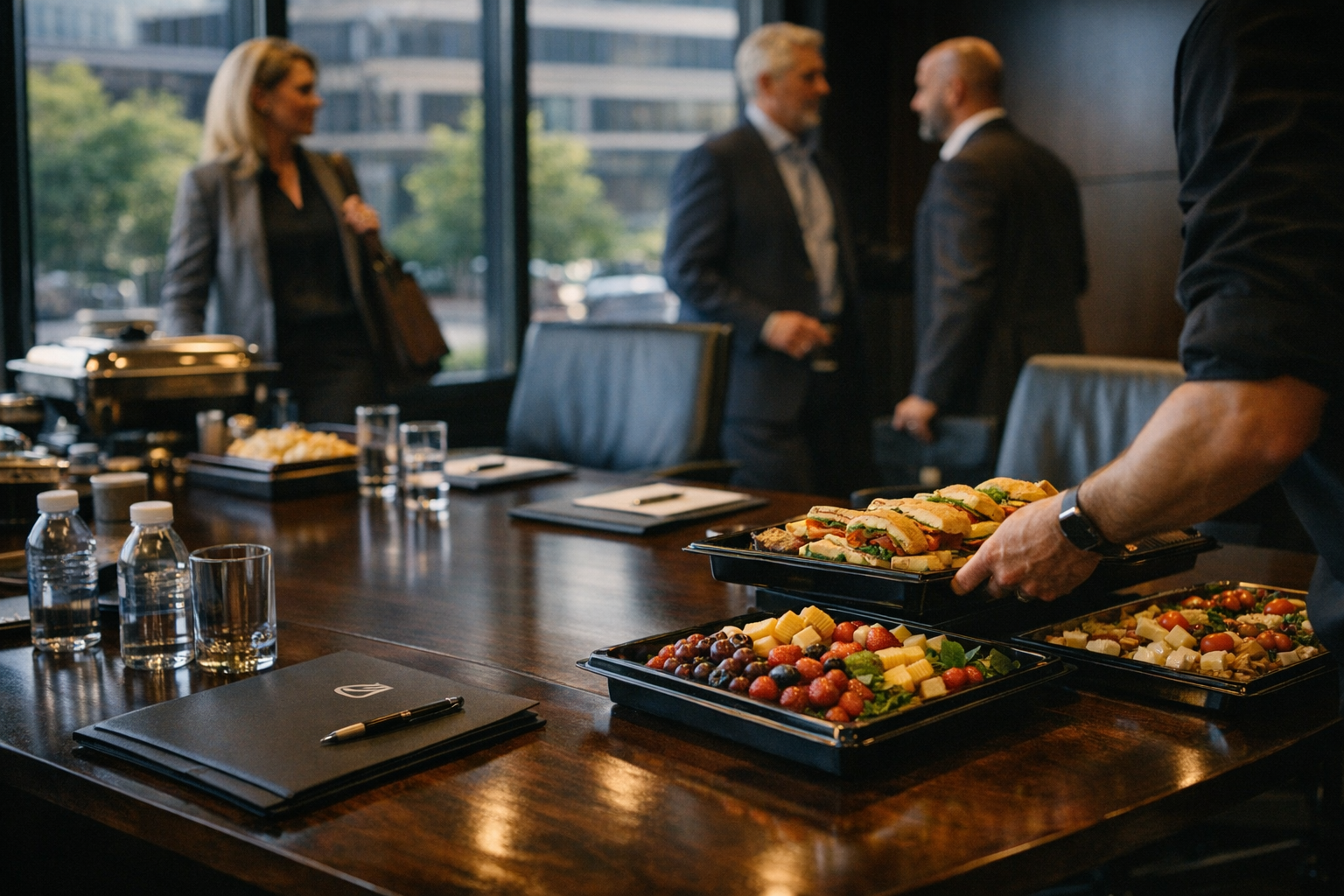
Corporate buyers are under pressure to choose vendors who will not create headaches. They want social proof that resembles their environment. They want testimonials from office managers, HR teams, school administrators, and business owners. They want polished photos of conference setups, executive lunches, employee appreciation events, and clean delivery presentation. They want to know that invoices will be correct, arrivals will be on time, dietary requests will not be mishandled, and communication will not break down an hour before the event.
If your competitor communicates all of that more clearly, they will keep winning contracts that you are fully capable of serving.
That is the frustrating truth for many catering companies: the gap is not always operational excellence. It is market clarity.
And market clarity has a direct revenue consequence. One recurring corporate account can be worth far more than a stream of one-off small events. Monthly office catering, quarterly executive meetings, recruiting events, board functions, holiday lunches, and team celebrations stack into predictable revenue. Losing those contracts is not a branding problem. It is a growth problem.
The companies that fix it usually do three things fast. They reposition around specific business use cases. They clean up the digital buying experience so corporate prospects can evaluate them without friction. And they gather visible proof that they are not just good caterers, but dependable business vendors.
That is what better-positioned competitors are doing while others are still assuming the food should speak for itself.
It does not.
Not in a corporate buying process.
Not in Westchester.
And not when the buyer has three tabs open and one of them makes the decision feel obviously safer.